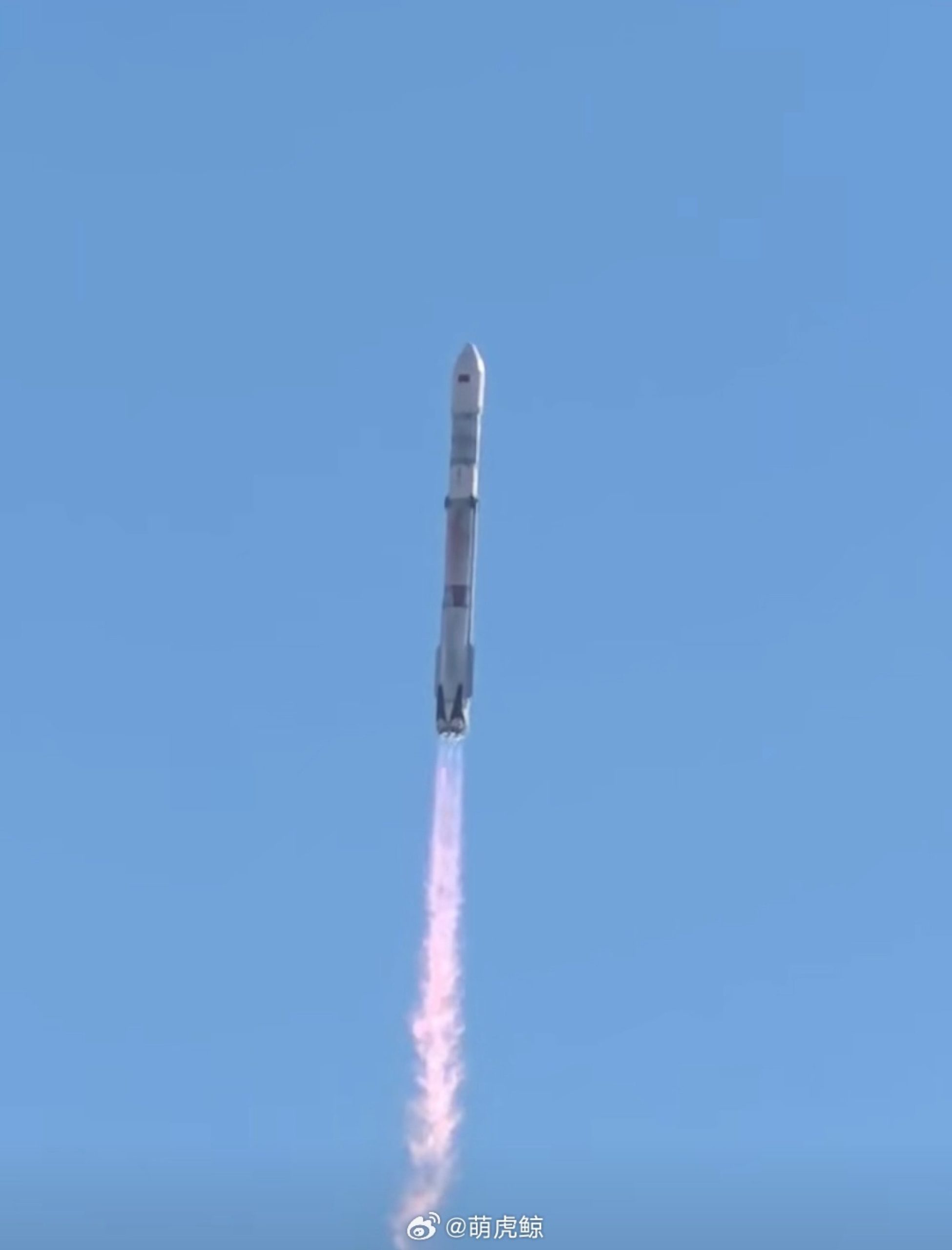
China’s initial recoverable rocket, the Zhuque-3, introduced for the first time on Wednesday and successfully entered orbit, but attempts to retrieve the first stage were unsuccessful as it crashed close to the designated recovery area.
The United States remains the sole nation to have successfully retrieved an orbital-class rocket stage, although China is striving to take the second position with several planned launches.
The recoverable rocket, developed by the Beijing-based private space firm LandSpace, was launched from the Jiuquan Satellite Launch Center in China’s northwest at noon on Wednesday.
Are you curious about the most significant issues and developments happening globally? Find the solutions withSCMP Knowledge, our latest platform offering carefully selected content including explainers, FAQs, analyses, and infographics, presented by our acclaimed team.
Once achieving a low-Earth orbit, the rocket’s first stage — the lower part responsible for propelling the vehicle from the ground — seemed to ignite mid-air before descending close to the intended recovery area.
The initial phase “encountered an issue” during the landing process and “did not manage to perform a gentle touchdown on the recovery platform,” LandSpace mentioned in a social media update.
The wreckage landed at the border of the landing area, leading to a unsuccessful recovery test. The exact reason is being examined in more detail.
LandSpace mentioned that various aspects of the mission—such as the launch, separation of the first and second stages, and the shutdown and restart of the second stage engine—were all executed according to plan.
“Although this mission did not meet the set objective of retrieving the rocket’s first stage, it confirmed the accuracy and logic of the entire procedure for testing, launching, and flying the Zhuque-3 rocket,” reported the Chinese state news agency Xinhua on Wednesday.
Chinese commercial and state-run space companies have been competing to launch the nation’s initial reusable rocket, a technology currently led by the United States.
SpaceX introduced reusable rocket technology, marking history by successfully landing a rocket following an orbital mission nearly ten years ago using the Falcon 9.
In November, Washington state-based Blue Origin’s New Glennbecame the second spacecraft to accomplish this milestone.
Advancements in reusable rocket technology could lead to reduced expenses for space launches and quicker preparation times, supporting more effective missions and the deployment of large-scale space initiatives – such as China’s upcoming internet satellite networks.
The Zhuque-3 stands at 66 meters (215 feet) in height and is 4.5 meters wide, featuring a first stage equipped with nine Tianque-12A engines.
The initial phase of the stainless steel rocket, which operates using liquid methane and liquid oxygen, was created to be utilized a minimum of 20 times.
In reusable mode, the Zhuque-3 has a payload capacity of 18 tonnes — featuring satellites that each weigh one tonne — which can aid in constructing internet satellite constellations that will compete with the Starlink system created by SpaceX.
Both the state-owned Guowang megaconstellation and the Qianfan project, supported by Shanghai, are developing networks consisting of up to 10,000 satellites.
In October, Elon Musk, the founder of SpaceX, mentioned on social media that the Zhuque-3 had outperformed the Falcon 9 in several important aspects, yet noted that the Starship—SpaceX’s upcoming reusable rocket being developed—was “in a completely different category.”
Other Chinese reusable rocket systems are anticipated to conduct their first launches in the near future.
A private enterprise named Space Pioneer’s Tianlong-3, along with a state-run Long March 12A, are also stationed at the Jiuquan Satellite Launch Centre, awaiting their launch.
The Long March 12A is also targeting a launch in December, with the goal of reaching orbit before returning its first stage to Earth.
The Long March 12A was developed by the Shanghai Academy of Spaceflight Technology, part of the China Aerospace Science and Technology Corporation, and has the capability to carry 12 tonnes into low-Earth orbit.
It is a reusable variant based on the Long March 12 — a kerosene-powered rocket used for launching internet satellites — which has also been enhanced to operate on methane.
In October, LandSpace stated that the Zhuque-3 successfully finished fueling drills and a full-length engine test.
Its debut was postponed followingSpace junk struck the Shenzhou-20 spacecraft.moored at the Tiangong space station, resulting in the mission crew needing to return to Earth using a different spacecraft.
The launch date for Zhuque-3 was initially scheduled for the end of November, but it was postponed once more. No explanation was provided.
More Articles from SCMP
‘Sweetest’ seafood, ‘delicious’ Indian: Hong Kong restaurant selections from the founder of Tabla
Elon Musk emphasizes his goal to turn X into a ‘WeChat++’ super app
A country shaped by design: how Singapore’s innovative mindset fuels its growth
Opponents advocate for insurance changes, simpler fire claims in Hong Kong election contest
This piece was first published in the South China Morning Post (www.scmp.com), a top news outlet covering China and Asia.