The declaration by President Donald Trump signifies a significant change in the US approach to limiting Chinese access to advanced semiconductor technology due to worries about its use in military contexts.
The United States will permitchip giant Nvidiato send its cutting-edge artificial intelligence chips to China, US President Donald Trump stated on Monday, following a deal he made with Chinese President Xi Jinping.
Nvidia is currently the top US company by market capitalization, having quickly risen with the AI wave.
The declaration signifies a significant change in the US’ technology export policy, particularly regarding cutting-edge AI chips. The previous administration of US President Joe Biden imposed strict limitations on the sale of advanced chips to China due to worries about their use in the Chinese military.
Trump announced in a post on Truth Social that he had told Xi that Washington would allow Nvidia to export its H200 products to “approved customers” in China and other nations, “under conditions that ensure ongoing strong National Security.”
“President Xi expressed approval! 25% will be sent to the United States of America,” he stated, noting that this action would help American taxpayers, create more jobs, and enhance US manufacturing.
A spokesperson from the White House explained that theA 25% charge would constitute an import duty.from Taiwan, where the chips are manufactured. They will be imported into the US for a security assessment prior to being sent to China.
Most sophisticated chips excluded from the agreement
The American president pledged that the country would continue to be at the forefront of AI, as US consumers were already shifting towards the highly advancedBlackwell chips, followed by the next generation Rubin chips, “none of which are included in this transaction.”
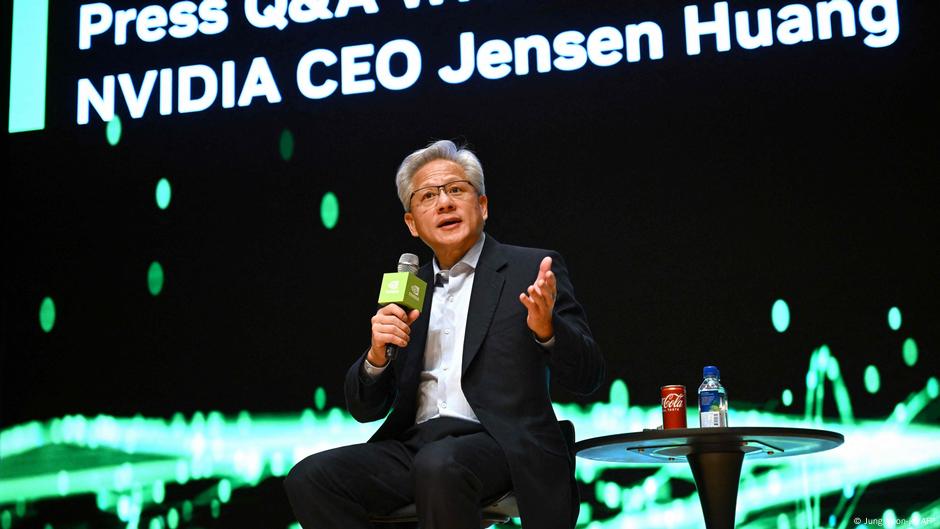
“Providing H200 to approved customers, verified by the Department of Commerce, represents a careful compromise that benefits America,” Nvidia stated. Its Chief Executive Officer Jensen Huang hasstrongly advocated to the White Houseto undo the policy implemented during Biden’s administration that limited China’s ability to obtain advanced chips.
Trump stated that the Department of Commerce was working on the final details, but the “same strategy will be applied to AMD,”Intel, and other great American companies.”
Democrats sound alarm bells
A number of Democratic senators in the US Senate responded to the agreement with a statement, describing it as a major economic and national security disaster.
“Obtaining these chips would provide China’s military with transformative technology, enabling its weapons to be more deadly, conducting more efficient cyberattacks on American businesses and vital infrastructure, and enhancing their economic and manufacturing capabilities,” the lawmakers stated.
Senators referenced a recent comment from the Chinese artificial intelligence firm DeepSeek, stating that limited access to high-end US-made chips was their primary obstacle in competing against American AI companies such as OpenAI, Google, Microsoft, and Perplexity.
In the meantime, Alex Stapp from the Washington-based Institute for Progress referred to the policy as a “major own goal,” using a football analogy. He mentioned that the H200 was “six times more potent than the H20, which had been the most powerful chip approved for export previously.”
The announcement of the deal follows several days after Massachusetts Senator Elizabeth Warren, a Democrat, hinted at a secret agreement between Trump and Huang that included a contribution to construct the East Wing Ballroom at the White House.
She mentioned in a post on X, “I’m questioning Microsoft, Nvidia, Meta, Apple, Amazon, Union Pacific, and Comcast regarding their contributions to Trump’s ‘Big Gold Ballroom.'”
Ball in China’s court
China is currently prohibiting its companies from utilizing American technologies, leaving uncertain whether Trump’s declaration will lead to a shift in policy in Beijing.
“Chinese companies are seeking H200s, but the Chinese government is motivated by suspicion and arrogance — suspicion regarding potential backdoors and reliance on American chips, and arrogance in promoting local alternatives,” said Craig Singleton, a senior fellow at the Washington-based think tank Foundation for Defense of Democracies.
“Washington might approve the chips, but Beijing still needs to allow their entry,” he added.